Dissemination and Implementation Study Designs


Learning Objectives:
To Demonstrate designs to achieve effectiveness of dissemination and implementation
What is the Research Question?
- Level of Evidence
- Implementation and Dissemination


What is the Right Design?
The stages of research and phases of dissemination and implementation
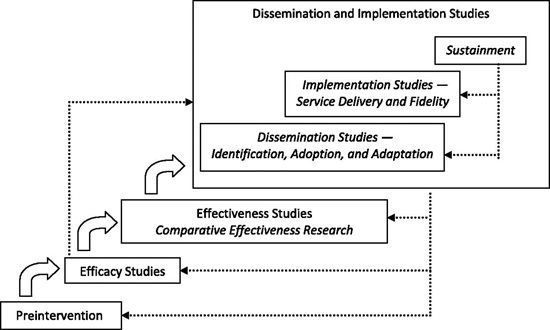
PREINTERVENTION
/PRELIMINARY
STEPPED
WEDGE
Involving random and sequential crossover of clustered groups
PRAGMATIC TRIALS/CER
DEMONSTRATION
/DISSEMINATION

RCT
Randomized Controlled Trial
- Efficacy
- Effectiveness
- Cluster Randomized
HYBRIDIZED
PRECIS-2
Pre-intervention Studies
RCT - Randomized Controlled Trial
FRAMEWORK
3
- Efficacy
- Effectiveness
- Cluster-Randomized
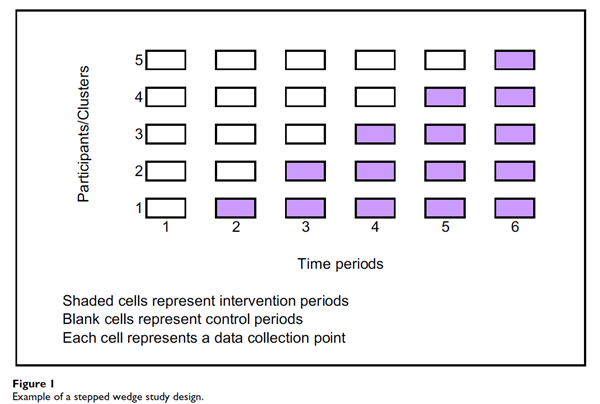
Stepped-Wedge Study Design
The stepped wedge cluster randomized trial
This is a research study design that is increasingly being used in the evaluation of service delivery type interventions. The design involves random and sequential crossover of clusters from control to intervention until all clusters are exposed.
More clusters are exposed to the intervention towards the end of the study than in its early stages, so sample size calculations and analysis must make allowance for both the clustered nature of the design and the confounding effect of time.
Hybrid Study Designs
Mixed Method Designs
"Hybrid (mixed method) designs focus on collecting, analyzing and merging both quantitative and qualitative data into one or more studies.
The Central Premise of these designs is that the use of quantitative and qualitative approaches in combination provides a better understanding of research issues than either approach alone. "
Pragmatic Trials
FRAMEWORK
3
Considerations for Pragmatic Trials
-
Pragmatic Trials allow us to evaluate interventions under typical conditions, with typical patients vs. under ideal conditions with a homogeneous set of selected patients (Explanatory Trials).
-
Traditional trials usually take a long time to translate into practice; it takes an average of 17 years for just 14% of research to translate into practice.
-
The conditions under which traditional trials are conducted are often not seen by practitioners as relevant to their practice or patient populations.
-
Although there are over 18,000 randomized controlled trials (RCT's) published each year, the vast majority of systematic reviews conclude that there is not enough evidence to inform clinical decisions.

PRECIS Evaluation Criteria
Is yours a pragmatic study, or an explanatory study?
No study is completely pragmatic, nor is it completely explanatory. Rather, each study is somewhere along the continuum, having characteristics and degrees of each study type.
The Pragmatic-Explanatory Continuum Indicator Summary (PRECIS) was developed by Thorpe and colleagues to measure where a given study might fall. It can be applied to illustrate the degree to which a trial is pragmatic or explanatory. It used ten domains plotted on a “spoke-and-wheel” diagram. Since then, it has been revised to feature 9 domains related to pragmatic trials.
To Learn more about PRECIS-2 and use our interactive PRECIS-2 Wheel;
See our e-book on Pragmatic Trials
Dissemination/Demonstration
FRAMEWORK
3
Dissemination/Demonstration Studies
Need some text for this - References, etc.?
Examples in practice: D&I Study Designs
- To be dissolved into other sections
Case Example : Mixed Methods Multiple Case Study
Context:
Improving quality in children’s mental health and social service settings.
Objective:
This study is designed to inform efforts to develop more effective implementation strategies by fully describing the implementation experiences of a sample of community-based organizations that provide mental health services to youth in one Midwestern city.Evaluation Design:
This qualitative work informs the development of a Web-based survey that will assess the perceived effectiveness, relative importance, acceptability, feasibility, and appropriateness of implementation strategies from the perspective of both clinicians and organizational leaders.
The Organizational Social Context measure will be used to assess organizational culture and climate.
Powell BJ, Proctor EK, Glisson CA, Kohl PL, Raghavan R, Brownson RC, Stoner BP, Carpenter CR, Palinkas LA. A mixed methods multiple case study of implementation as usual in children’s social service organizations: study protocol. Implement Sci. 2013; 8: 92.
Case Example : Pragmatic implementation trial in primary care
Context:
Understanding patient-centered health behavior and psychosocial issues in primary care.
Objective:
Our goal is to design a scientifically rigorous and valid pragmatic trial to test whether primary care practices can systematically implement the collection of patient-reported information and provide patients needed advice, goal setting, and counseling in response.Evaluation Design:
Stakeholder groups are engaged throughout the study design to account for local resources and characteristics.
Study outcomes include the intervention reach (percent of patients offered and completing the MOHR assessment), effectiveness (patients reporting being asked about topics, setting change goals, and receiving assistance in early versus delayed intervention practices), contextual factors influencing outcomes, and intervention costs.
Krist AH, Glenn BA, Glasgow RE, Balasubramanian BA, Chambers DA, Fernandez ME, Heurtin-Roberts S,Kessler R, Ory MG, Phillips SM, Ritzwoller DP, Roby DH, Rodriguez HP, Sabo RT, Sheinfeld Gorin SN,Stange KC; MOHR Study Group. Designing a valid randomized pragmatic primary care implementation trial: the my own health report (MOHR) project. Implement Sci. 2013;8:73.
Case Example : Implementation in a VA setting
Context:
Heart failure is the primary reason for discharge from the VA medical service. Furthermore, the readmission rate is high.The Hospital to Home (H2H) Excellence in Transitions Initiative is a new national campaign to reduce preventable readmissions for patients recently hospitalized with a cardiovascular condition (www.H2Hquality.org).
Objective:
- To determine if VA facility enrollment in H2H results in improved care for VA patients with heart failure.
- To determine barriers and facilitators to a) enrolling facilities in H2H, and for those facilities enrolled, b) adopting the H2H interventions.
- To evaluate the use of the VA Heart Failure Network to aid in implementing the H2H initiative in a randomized trial. (HF Network
Implementation Design:
All the intervention facilities were asked to participate by (1) enrolling their facility at the H2H website as commitment to, and (2) initiating projects based on the VA H2H initiative. In Month 6 surveys were sent to both the intervention and control facilities to assess participation in the VA H2H initiative. From Month 7 to Month 12 the VA H2H initiative is being facilitated at all remaining 61 control facilities.
Case Example : Implementation Design In HMO
Context:
Implementing and disseminating an evidence-based model of well-child care (WCC) that includes developmental and preventive services recommended by the American Academy of Pediatrics.Implementation Design:
Twenty-first Century WCC is a parent-centered, team-based, primary care model that combines online pre-visit assessments—completed by parents and caregivers—with vaccinations and anticipatory guidance.Nurses, nurse practitioners, developmental specialists, and pediatricians all play roles in the WCC model.
Patient and clinician interaction, health records, and resources are all facilitated through a Web-based diagnostic, management, tracking, and resource information tool.
Unlike innovations that are embedded only in technical systems, validated models of team-based health care have multiple components that must be made compatible with complex sociotechnical systems. Interpersonal communication, work, coordination, and judgment are key processes that affect implementation quality. Implementation can involve tailoring to a particular site and customizing either the model or the organizational context to accommodate it.
Resources

AHRQ Effective Healthcare Program
CDC Tools for Community Action
AHRQ Healthcare Innovations Exchange

Key Takeaways
Click To Reveal Flipcard Answer
Before Addressing an Issue, one should know “the root of the problem.” What does this mean?
Know “what” is occurring and “why” before addressing an issue!
What are the four considerations for D&I planning?
Evidence, Audience, Engagement and Translation
Evidence: Questions to ask
- Is the evidence for intervening compelling?
- Has efficacy been demonstrated?
- Has effectiveness been demonstrated?
Audience: Questions to ask
- Who is the primary audience? Do you understand their attitudes/beliefs/current practices?
- What is the setting?
- Are there other stakeholders affected? Where do they stand on it? (for, against, neutral)
Engagement: Questions to ask
- What kind of partnerships should be developed?
- What communication norms do your audience prefer?
- Be prepared and receptive to a re-framing of intervention/study questions and D&I strategies; it is iterative!
- Remember stakeholder involvement enhances dissemination of the findings.
Translation: Questions to ask
- Are there relevant implementation toolkits that can be used or adapted?
- Remember: Multilevel approaches are better than single-prong strategies for successful translation.
What 4 elements are in the Consolidated Framework for Implementation Research?
- Characteristics of intervention
- Inner/outer settings
- Characteristics of individuals
- Characteristics of the process


Checklist To Get Started
-
What am I disseminating and implementing? Is it worthy of broad-scale adoption?
-
Who are my target audience(s) for behavior change? Do I understand their knowledge, attitudes, beliefs, and behaviors about what I want to disseminate and implement?
-
Who are other stakeholders affected by the implementation? What are their opinions – are they in favor, against, or neutral? How might this influence adoption among my target audience? How should I address this?
-
How does my target audience view what I want to disseminate and implement? Can I frame what I want to disseminate and implement so the value-added benefit is clear and persuasive?
-
What are potential barriers to adoption that I should address in the design of my translation plan? What are potential facilitators that I can leverage?